The first UVS Oman

The first annual Unmanned Vehicle Systems Oman recently finished in Muscat and was by all counts a success. It was a small but potent conference (which is an important combo for ambitious firsts), the hosting was quite exemplary, the space (the campus of Sultan Qaboos University) exquisite, and the talks were a wonderful stretch for me both into areas I don’t think much about, like controller design … Continue reading The first UVS Oman

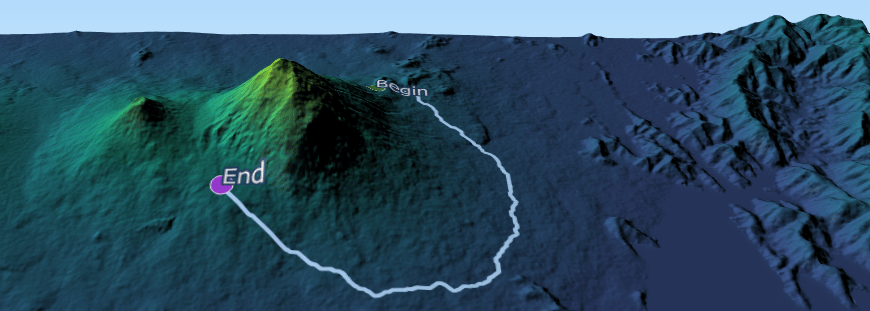
Least-cost path around Volcan Muhabura; or how to avoid volcanos with GRASS GIS in 3D

Least Cost Path or How to Avoid Volcanoes with GrassGIS

Recently (ok, I have been working on-and-off on this for longer than I’d like to admit) we needed to solve a least cost path problem. I poked around and looked at a few solutions. One was in Jared Erikson’s Python GDAL/OGR Cookbook which was fun to play with. This is a fun solution as it’s pretty low level, so you can see all the parts and … Continue reading Least Cost Path or How to Avoid Volcanoes with GrassGIS

Classifying point clouds with CGAL

There exist all sorts of interesting point cloud classification approaches, many of them open source and accessible. A set of particularly interesting ones have been released recently via the Computational Geometry Algorithms Library, or CGAL. The description of the CGAL from their web page is as follows: CGAL is a software project that provides easy access to efficient and reliable geomeric algorithms in the form of a … Continue reading Classifying point clouds with CGAL

Better 3D all the time

Reblogged from the OpenDroneMap blog. Recent posts have detailed the improvements in the digital elevation products from OpenDroneMap that are forthcoming, and we are really excited about those. That code is now relatively mature and likely usable for your use case, with only a couple of caveats: The first caveat is that the processing for point clouds takes 3-4 times as long. That said, the … Continue reading Better 3D all the time

Digital Elevation Model Improvements, cont. with code!

(Reblogged from the OpenDroneMap blog) Ok, so far what is available is broken code but that will be fixed.  You can check it out in the meantime in this pull request. It calculates the full depthmaps, but does not yet write the PLY file needed for subsequent steps. The trick to improve DEMs was already in our build process: for elevation models, MVE’s dmrecon utility … Continue reading Digital Elevation Model Improvements, cont. with code!

Water runs downhill

(Originally published here: https://www.opendronemap.org/2018/11/water-runs-downhill/) Water running downhill is a challenge for elevation models derived from drone imagery. This is for a variety of reasons, some fixable, some unavoidable. The unavoidable ones include the challenges of digital terrain models derived from photogrammetric point clouds, which don’t penetrate the way LiDAR does. The avoidable ones we seek to fix in OpenDroneMap.   The fixable problems include poorly … Continue reading Water runs downhill